Explanation of the Functions of Each Component in an RC Car ESC

The main components of an RC car electronic speed controller (ESC) include a microcontroller (MCU), MOSFET transistors, gate drivers, capacitors, a battery elimination circuit (BEC), and electronic components such as current, voltage, and temperature sensors. Each electronic component plays a crucial role in the RC car ESC.
MCU MCU stands for microcontroller unit. In an RC car ESC, it is responsible for processing remote control signals from the user as well as feedback signals from the motor and the circuit itself. It then performs high-speed calculations based on its internal preset program to generate commands that direct the circuit to drive the motor. The performance, programmable parameters, and control accuracy of the ESC depend largely on the performance of its MCU.
MOSFET Transistors
A MOSFET is a voltage-controlled, ultra-high-speed electronic switch. In an RC car ESC, it rapidly turns the current path from the battery to the motor on or off at an extremely high frequency, based on commands sent by the MCU.
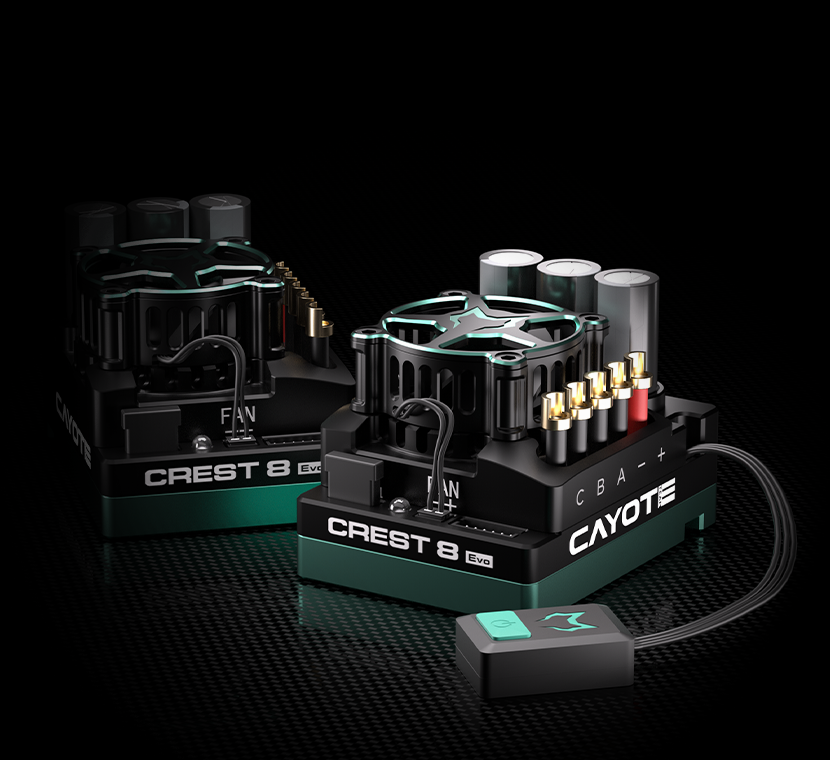
The ESC’s continuous current, peak current capacity, and overall efficiency all depend directly on the performance of the MOSFETs used. They are the components in the RC car electronic speed controller that generate the most heat.
Gate Driver The control signals generated by the MCU are weak logic-level signals that cannot directly and rapidly drive power MOSFETs. This is where the gate driver comes into play: it amplifies the MCU’s weak signals into drive signals with sufficient peak current to enable the MOSFET to turn on and off rapidly.
Capacitors Because MOSFETs turn on and off at high speeds, the current changes rapidly, causing voltage fluctuations. Capacitors are therefore needed to stabilize the power supply, absorb voltage fluctuations, and suppress electrical noise, thereby ensuring the stable operation of the RC car ESC.
Battery Elimination Circuit (BEC) The receiver and steering servos on a radio-controlled car also require a stable, low-voltage power supply to operate. The BEC is used to convert the battery’s higher voltage into the lower, regulated voltage required by the receiver and servos.
Current/Voltage/Temperature Sensors These sensors are used to monitor various conditions inside and outside the ESC in real time, ensuring stable and safe operation under all conditions and preventing damage to the ESC itself or the motor caused by unexpected situations such as overloads, short circuits, or overheating.
The selection of each component and the circuit layout directly determine the ESC’s performance and handling feel.
CAYOTE specializes in the research and development of professional racing RC car ESCs and RC car power systems. By utilizing high-specification hardware and finely tuned algorithms, CAYOTE provides drivers with the ultimate driving experience. Visit CAYOTE to learn more about our products.